Hi! Here are my answers to TB page 81... What do you think? :)
I always rely on the number of marks to see how much write... These questions don't state the number of marks so I just wrote how much I think is correct :P
1) The fact that planes can hold more people and can also make continuous flights. This would shorten trips as the planes don't have to stop for breaks. This also can save money, as this plane may be able to replace many other planes. Planes would be able to travel long distances too.
2) The disadvantages of buying this plane would be the cost of the plane. Such a large plane would cost a lot. This also includes the maintainance fees, which would cost far more than a normal plane. The advantages include the plane would get the company a lot of profit as the plane would be able to take over a lot of planes and those planes would be able to take other flights. This plane would also help to save a lot of money as this plane can fly many flights and the company would not need to buy new planes.
Thursday, June 14, 2012

Sunday, June 10, 2012
My response to the textbook's Article ( Skills Builder: Pg. 81)
In this blog post, I will be sharing some of my responses towards the questions in the textbook. However, I am still not clear in some areas. I hope to have my doubts clarified so any other responses are welcome.
1. From the article, identify some technological developments in air transport.
My response:
Planes from the past can only fly a very limited distance due to their materials (durability), speed (engines), low oil capacity and many other factors. Therefore, people would have to fly to certain airports in different countries to change their plane flight in order to get to their destination. However now, newer planes are designed to fly a longer distance and travel at a faster time. People gain a non-stop service when they get on the plane instead of having to waste time to change planesat certain airports. For example, the new Boeing-777 that is mentioned in the article is able to fly a total of 17 466 Km, which is 2 775 Km more than other boeing planes that have been designed. This shows that the plane is able to fly a longer distance because of the advancement of technology due to better engines, higher oil capacity and better materials. It is the world's longest range airliner which can carry about 301 passengers when average airplanes designed previously can only carry from 150 to 230 passengers one flight through. This means that more people can fly directly to their destinations through the more space designed using technology.
2. What do you think are some of the advantages and disadvantages of airline companies buying the 777-200LR?
My response:
The good thing about buying this type of airliner will prove the airliner's efficiency in connecting the passengers to the rest of the world using a fast and the newest plane, hence dominating other airlines and profiting in the end. However, the company will not profit anything if they just some Airbus planes as they are somewhat similar to boeing's new plane.
I am not so sure about the second question though. I hope everyone would make an effort to help me with this. The more responses the better!
Cheers!
Chrystal :D
1. From the article, identify some technological developments in air transport.
My response:
Planes from the past can only fly a very limited distance due to their materials (durability), speed (engines), low oil capacity and many other factors. Therefore, people would have to fly to certain airports in different countries to change their plane flight in order to get to their destination. However now, newer planes are designed to fly a longer distance and travel at a faster time. People gain a non-stop service when they get on the plane instead of having to waste time to change planesat certain airports. For example, the new Boeing-777 that is mentioned in the article is able to fly a total of 17 466 Km, which is 2 775 Km more than other boeing planes that have been designed. This shows that the plane is able to fly a longer distance because of the advancement of technology due to better engines, higher oil capacity and better materials. It is the world's longest range airliner which can carry about 301 passengers when average airplanes designed previously can only carry from 150 to 230 passengers one flight through. This means that more people can fly directly to their destinations through the more space designed using technology.
2. What do you think are some of the advantages and disadvantages of airline companies buying the 777-200LR?
My response:
The good thing about buying this type of airliner will prove the airliner's efficiency in connecting the passengers to the rest of the world using a fast and the newest plane, hence dominating other airlines and profiting in the end. However, the company will not profit anything if they just some Airbus planes as they are somewhat similar to boeing's new plane.
I am not so sure about the second question though. I hope everyone would make an effort to help me with this. The more responses the better!
Cheers!
Chrystal :D
Tuesday, May 1, 2012
Globalisation and Transhipment
What is globalisation? When asked to define globalisation, it is a growth to a global or worldwide scale; "the globalisation of the communication industry". Globalisation refers to the increasing global relationships of culture, people, and economic activity. It is generally used to refer to economic globalisation: the global distribution of the production of goods and services, through reduction of barriers to international trade such as tariffs, export fees, and import quotas and the reduction of restrictions on the movement of capital and on investment. Globalization may contribute to economic growth in developed and developing countries through increased specialization and the principle of comparative advantage. The term can also refer to the transnational circulation of ideas, languages, and popular culture.
So at the mention of globalisation, it is also part of the topic we are learning now, transport and communication.
"The technological revolution and social dimensions of modernity have made this increased interconnectedness possible. Advancements in technology have made quick and radical improvements in communication and transportation capabilities. The social dimension of modernity contributes the assertion that because all men and women are equally valuable, they should be free from unfulfilling constraints imposed by other persons or the state. These technological capacities and the freedom to develop and use them promise to enhance the potential for integral human development by promoting authentic development in at least the areas of economics, politics, and culture. In economics, globalization broadens the free market to include many nations to which it had not previously reached. Improvement in the political arena is recognized in a newfound permeability of borders that allows for an exchange of information that can undermine the power of abusive regimes. The effects of globalization on culture—society’s shared idea of human good and morality—can also be positive in that never in history have these societal ideas and cultural characteristics been so easy to share."
This is a quote from an article about the phenomenon about globalisation. It explains how globalisation has become part of our daily lives through many things like economics, politics and social areas.
To read on and to understand more about the phenomenon of globalisation, you can go to the link below! :D
http://www.acton.org/pub/religion-liberty/volume-12-number-5/phenomenon-globalization
The next thing I would like to blog about would be a term called "transhipment". When defined on the internet, it is known as a is the shipment of goods or container to an intermediate destination, and then from there to yet another destination. Ms J left us some self work when she was unable to come for the lesson on Wednesday and Joanne and I explored a number of questions based on transhipment. Singapore's airport is busy with flights taking off everyday. Moreover, many foreigners catch a plane to Singapore just to go to other places like Japan or London. Why do they do that when they can catch a direct flight to their destination?
In her notes, Ms J says that one main reason would be that Singapore's airport offers a choice of airlines, and if the foreigners wait at their own airport, there may be only one flight to the desinated place. It happens just the same for the loading and unloading of goods. Why do ships choose to stop by at Singapore instead of going directly to the desinated place? Reason being, the number of journeys to go to places is greatly reduced and hence speeds up the transactions. Without transhipment, if each vessel connects to every port, the whole transportation system will be in a mess and will be complicated.
Thus, transhipment is much faster than direct shipping.
Chrystal
So at the mention of globalisation, it is also part of the topic we are learning now, transport and communication.
"The technological revolution and social dimensions of modernity have made this increased interconnectedness possible. Advancements in technology have made quick and radical improvements in communication and transportation capabilities. The social dimension of modernity contributes the assertion that because all men and women are equally valuable, they should be free from unfulfilling constraints imposed by other persons or the state. These technological capacities and the freedom to develop and use them promise to enhance the potential for integral human development by promoting authentic development in at least the areas of economics, politics, and culture. In economics, globalization broadens the free market to include many nations to which it had not previously reached. Improvement in the political arena is recognized in a newfound permeability of borders that allows for an exchange of information that can undermine the power of abusive regimes. The effects of globalization on culture—society’s shared idea of human good and morality—can also be positive in that never in history have these societal ideas and cultural characteristics been so easy to share."
This is a quote from an article about the phenomenon about globalisation. It explains how globalisation has become part of our daily lives through many things like economics, politics and social areas.
To read on and to understand more about the phenomenon of globalisation, you can go to the link below! :D
http://www.acton.org/pub/religion-liberty/volume-12-number-5/phenomenon-globalization
The next thing I would like to blog about would be a term called "transhipment". When defined on the internet, it is known as a is the shipment of goods or container to an intermediate destination, and then from there to yet another destination. Ms J left us some self work when she was unable to come for the lesson on Wednesday and Joanne and I explored a number of questions based on transhipment. Singapore's airport is busy with flights taking off everyday. Moreover, many foreigners catch a plane to Singapore just to go to other places like Japan or London. Why do they do that when they can catch a direct flight to their destination?
In her notes, Ms J says that one main reason would be that Singapore's airport offers a choice of airlines, and if the foreigners wait at their own airport, there may be only one flight to the desinated place. It happens just the same for the loading and unloading of goods. Why do ships choose to stop by at Singapore instead of going directly to the desinated place? Reason being, the number of journeys to go to places is greatly reduced and hence speeds up the transactions. Without transhipment, if each vessel connects to every port, the whole transportation system will be in a mess and will be complicated.
Thus, transhipment is much faster than direct shipping.
Chrystal
Tuesday, April 24, 2012
Transport and Communications All Over the World
Transport and Communications
Singapore's transport is definately one of the world's most compliated and advanced. When Ms J told us about her experience in the different transport in different parts of the world ('Thanks mate!'), it kinda struck me how different Singapore's transport is so different from the rest of the world's. Here are some of the unique transport in 2 very different countries: Bangkok (a less developed country) and Paris (a developed country)!
Transport in Bangkok (Also known as 'The Big Mango')
In Bangkok, there are many different types of transport. They have the Skytrain (BTS), MRT, river taxis, taxis and Tuk-tuks. Traffic in Bamgkok is usually hectic, but it's always easy to navigate around. I was most interested in the tuk-tuks (I love the ring of it!), so I went to check it out.



Sorry... I can't find the map that has only Metro trains (this one includes RER trains). However, even when it is enlarged, you still can't see the names of the stations! 370 stations in one map... it looks so much more modern than Bangkok's! Thus I think that transport in a country can determine how advanced a country is... am I right? Anyway, if you think that the MRT map in Singapore (which has only 89 stations) is so complicated I guess we should be thankful that Singapore isn't as big as Paris is ;).


http://www.bangkok.com/information-travel-around/
http://www.bangkok.com/information-travel-around/tuk-tuks.htm
http://4th-see.com/index.php?name=content&page_id=18
http://www.bangkok.com/bts/
http://paris.conciergerie.com/travel_paris/paris_public_transportation.php
http://en.wikipedia.org/wiki/List_of_Singapore_MRT_stations
http://parisbytrain.com/paris-rer/
http://paris.conciergerie.com/travel_paris/paris_public_transportation.php
http://www.wildjunket.com/2010/02/25/around-the-world-on-10-unique-transport-modes/
http://blog.greenearthbamboo.com/20100125/bamboo-marvels/travel-by-bamboo-trains-in-cambodia-true-ingenuity/
Singapore's transport is definately one of the world's most compliated and advanced. When Ms J told us about her experience in the different transport in different parts of the world ('Thanks mate!'), it kinda struck me how different Singapore's transport is so different from the rest of the world's. Here are some of the unique transport in 2 very different countries: Bangkok (a less developed country) and Paris (a developed country)!
Transport in Bangkok (Also known as 'The Big Mango')
In Bangkok, there are many different types of transport. They have the Skytrain (BTS), MRT, river taxis, taxis and Tuk-tuks. Traffic in Bamgkok is usually hectic, but it's always easy to navigate around. I was most interested in the tuk-tuks (I love the ring of it!), so I went to check it out.
- Tuk-tuks (derieved from the sound the engine makes)
This type of transport is a traditional type of transport and could be found long before the BTS, MRT and taxis. It is currently vanishing because modern transport such as the BTS are taking over. Tuk-tuks originated from the rickshaws in WWII, which were pulled by men and had a small engine. Now, riding in a Tuk-tuk is more of an experience rather than going around, and is also a tourist attraction.
Fees vary and depend on the distance travelled, tine of the day (such as peak hours), traffic and (interestingly!) the mood of the driver. A short trip would cost around 30 baht (around $1.21 in Singapore). However, because the price is 'flexible', people say that negotiating is a must. Also, taking a Tuk-tuk is rather expensive (taking a taxi may be cheaper then taking a Tuk-tuk!).
- BTS

This is somewhat like the usual LRT we see in Singapore. BTS have 2 different lines:

The Silom Line and the Sukhumvit Line. The Silom Line (light green in the map) runs west south, between the National Stadium to the Siam shopping centre in Wongwian Yai in Thonburi (which is actually across a river!). The Sukhumvit Line (darker green in the map) runs north east from Mo Chit to On Nut. Both lines meet at Siam Station (poor thing, the have to go all the way there to change line!). Fares start from 15 baht at one stop and the last train leaves between 2230 to 2250. They have peak hours like Singapore's MRT too, and that is 7am to 9am and 4pm to 7pm as it is a popular mode of transport for everyday life.
Transport in Paris (The City Of Light and Love!)
There are many ways to travel in Paris, and that includes the Metro, RER trains and Paris buses.
- Metro trains

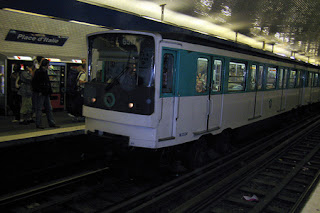
Metro trains are not only found in Paris. They can be found in Chicago, Melbourne, Washington DC and Los Angeles. It is a popular mode of transport there and about nine million passengers board the metro train everyday. Yep, and it sure is complicated! It has 200 kilometres of track and 370 stations... wanna see the map?

Metro lines are numbered from 1 to 15, and the direction of the train is indicated by the last stop of that train. For example, eastbound Line 1 trains are labeled as Chateau de Vincennes, while westbound Line 1 trains are labeled as La Defense. People have to board the trains using their 'Paris Metro Pass' (Which can be used to take other types of transport too. Watch video in here to learn more http://paris.conciergerie.com/pass/paris_metro_pass.php). Trains start at 0530 and end at 0030.
RER Trains

RER trains look a lot like MRTs in Singapore, don't they? Plus, there is a double-decker type too! Here is the map for RER trains:

There are 5 lines in RER trains, A (red line), B (blue line), C (yellow line), D (green line) and E (pink line). They are available from 0530 to 0030, just like the metro train. Actually, there is also a map that combines both the metro trains' map and the RER trains' map (the one in the 'metro trains' part), and it is REALLY complicated. One look and I found my first reason why I should not go to Paris (although I am still going. Duh... not even 50 reasons would keep me from going to Paris!!!).
Unlike metro trains that only cover 2 zones, RER trains cover 5 zones of the province which contains Paris! Also, RER trains connects major tourist attracttions and ports of entry to the heart of Paris, which is near St. Michel- Notre Dame.
I wonder why not the Eiffel Tower? :)
Actually, there are so many more unique and interesting modes of transport in the world...
and one that caught my eye was the Bamboo train that can be found in Cambodia...
Bamboo train (aka Norries, 'Bamboo slab on wheels')

Bamboo trains can be found in Cambodia. Bamboo trains are simple trains that are made of Bamboo and are usually handcrafted by the Cambodians themselves. Transportation in Cambodia (country destroyed by years of civil war) is a struggle. Cambodians actually have trains but they run infrequently. Moreover, trips on the trains are long as breakdowns and derailments are common. Thus, Cambodian villagers have come up with a simple version of the train- the bamboo train.
The bamboo trains are made of a combination of strong and abundant bamboo, as well as parts of abandoned military tanks. The original bamboo trains originated in the 1970s, and were controlled by a series of levers and hand-cast controls. Now they have wooden footbrakes too, which were provided by the United Nations relief effort in the 1980s.
Bamboo trains 'ride on existing tracks and spurs. Here comes the interesting part: when a bamboo train meets another on the same track, the train with the least passengers carries the bamboo train off the track to let the other go by. Once they meet the end of the track, they carry the train and head back. How... cute!
These trains provide a link between villages, as well as a way to get animals, produce and building materials to the market. It is also a means of income, because many rich tourists pay them up to $2 a day, which is actually 2 months' pay for the people in Cambodia.
What is typed here about the bamboo train comes alive HERE... As I watched this video, I giggled at the pure simplicity of this train, but even so I could not help but be grateful for the advanced technology and transport in Singapore. Our lives here are made so convinient. Thank God for blessing our beautiful Singapore!
Joanne
References:
http://www.bangkok.com/information-travel-around/
http://www.bangkok.com/information-travel-around/tuk-tuks.htm
http://4th-see.com/index.php?name=content&page_id=18
http://www.bangkok.com/bts/
http://paris.conciergerie.com/travel_paris/paris_public_transportation.php
http://en.wikipedia.org/wiki/List_of_Singapore_MRT_stations
http://parisbytrain.com/paris-rer/
http://paris.conciergerie.com/travel_paris/paris_public_transportation.php
http://www.wildjunket.com/2010/02/25/around-the-world-on-10-unique-transport-modes/
http://blog.greenearthbamboo.com/20100125/bamboo-marvels/travel-by-bamboo-trains-in-cambodia-true-ingenuity/
Sunday, April 8, 2012


New chapter: Transport and communication
Majority of the people living in Singapore take public transport due to its saving of time and money. I do dare say that Singapore's transport system is definitely one of the best in the world, although on rainy days it does get a little frustrating with the slowing down of traffic.
Below shows pictures of Singapore's MRT map and different types of traffic jams in the world. We can see that actually, Singapore is quite well connected from one place to another and for this, her citizens can travel to places while saving time and with convenience.
Now, let's look at the pictures of the traffic jams shown below. During traffic jams, people get really frustrated as they could not get to places on time. The second picture's traffic jam shows a more serious condition whereby the whole road is congested with cars and there are the "4th" or "5th" more lanes in order for the traffic to move. The third picture shows the longest traffic jam in the world in China. 
Sunday, April 1, 2012
Define: Eutrophication
Hey there everyone! Just wanted to share some interesting definitions on Eutrophication!
Eutrophication - "Eutrophication is defined as an increase in the rate of supply of organic matter in an ecosystem.” - Nixon, 1995
Eutrophication - “The process by which a body of water acquires a high concentration of nutrients, especially phosphates and nitrates. These typically promote excessive growth of algae. As the algae die and decompose, high levels of organic matter and the decomposing organisms deplete the water of available oxygen, causing the death of other organisms, such as fish.
Eutrophication is a natural, slow-aging process for a water body, but human activity greatly speeds up the process.” - Art, 1993
Eutrophication - “The term 'eutrophic' means well-nourished; thus, 'eutrophication' refers to natural or artificial addition of nutrients to bodies of water and to the effects of the added nutrients….When the effects are undesirable, eutrophication may be considered a form of pollution.” - National Academy of Sciences, 1969
Eutrophication – “The enrichment of bodies of fresh water by inorganic plant nutrients (e.g. nitrate, phosphate). It may occur naturally but can also be the result of human activity (cultural eutrophication from fertilizer runoff and sewage discharge) and is particularly evident in slow-moving rivers and shallow lakes … Increased sediment deposition can eventually raise the level of the lake or river bed, allowing land plants to colonize the edges, and eventually converting the area to dry land.” - Lawrence and Jackson, 1998Eutrophic – “Waters, soils, or habitats that are high in nutrients; in aquatic systems, associated with wide swings in dissolved oxygen concentrations and frequent algal blooms.” - Committee on Environment and Natural Resources, 2000
Eutrophication - "Eutrophication is defined as an increase in the rate of supply of organic matter in an ecosystem.” - Nixon, 1995
Eutrophication - “The process by which a body of water acquires a high concentration of nutrients, especially phosphates and nitrates. These typically promote excessive growth of algae. As the algae die and decompose, high levels of organic matter and the decomposing organisms deplete the water of available oxygen, causing the death of other organisms, such as fish.
Eutrophication is a natural, slow-aging process for a water body, but human activity greatly speeds up the process.” - Art, 1993
Eutrophication - “The term 'eutrophic' means well-nourished; thus, 'eutrophication' refers to natural or artificial addition of nutrients to bodies of water and to the effects of the added nutrients….When the effects are undesirable, eutrophication may be considered a form of pollution.” - National Academy of Sciences, 1969
Eutrophication – “The enrichment of bodies of fresh water by inorganic plant nutrients (e.g. nitrate, phosphate). It may occur naturally but can also be the result of human activity (cultural eutrophication from fertilizer runoff and sewage discharge) and is particularly evident in slow-moving rivers and shallow lakes … Increased sediment deposition can eventually raise the level of the lake or river bed, allowing land plants to colonize the edges, and eventually converting the area to dry land.” - Lawrence and Jackson, 1998Eutrophic – “Waters, soils, or habitats that are high in nutrients; in aquatic systems, associated with wide swings in dissolved oxygen concentrations and frequent algal blooms.” - Committee on Environment and Natural Resources, 2000
Subscribe to:
Posts (Atom)
